Digital Marketing Agency
Digital Marketing Agency
Digital Marketing Agency
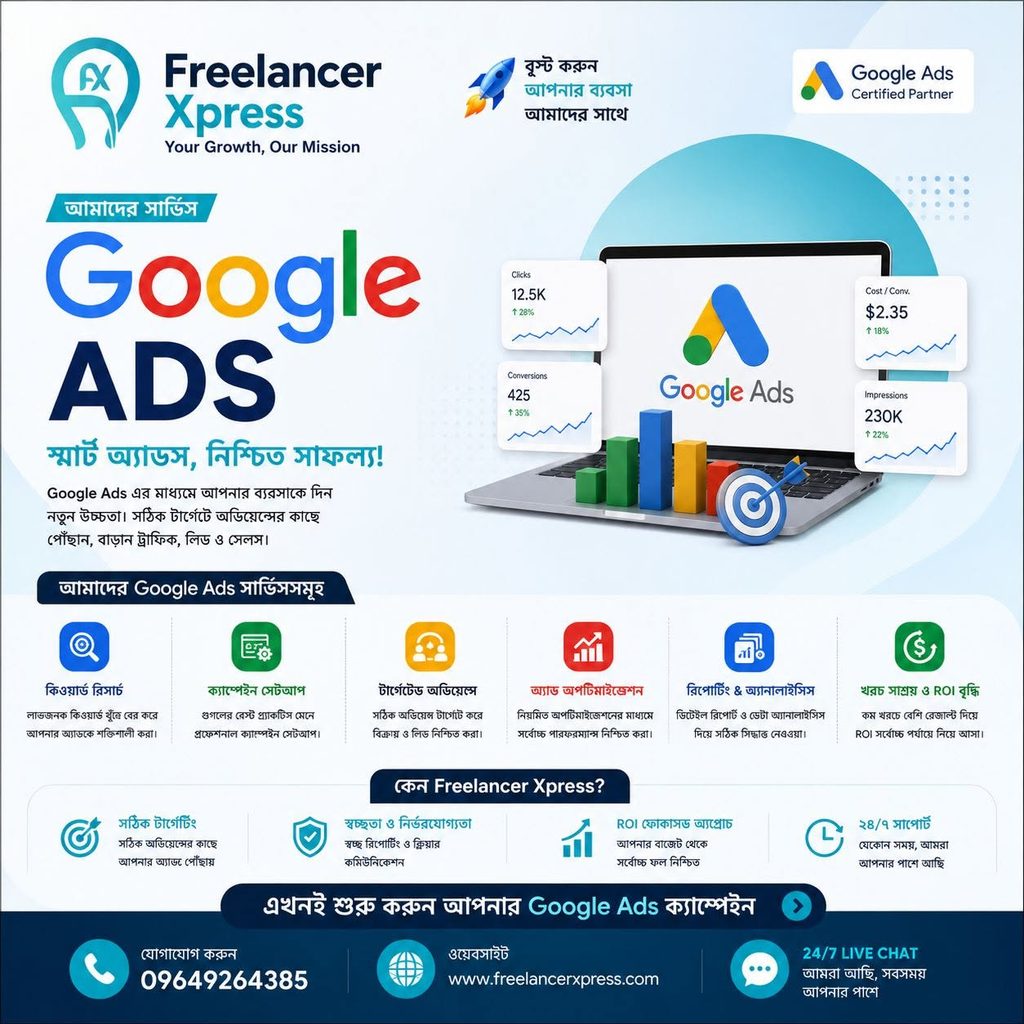
Google Advertising helps businesses promote their products and services through Google Ads. When people search for specific products or services, relevant ads can help businesses reach potential customers at the right time.
A Digital Marketing Agency can manage Google Ads campaigns through keyword research, audience targeting, ad creation, budget planning, and campaign optimization. By analyzing campaign performance, agencies can identify what drives clicks and conversions and continuously improve results.
With the right strategy and ongoing optimization, a Digital Marketing Agency can help businesses reach their target audience and grow their online presence.
The primary platform for this is Google Ads. Through it, an advertiser can create and manage various types of advertising campaigns for their business, product, or service. Specific keywords, audiences, locations, and other targeting criteria can be utilized depending on the campaign.
How does Google Ads work?
Suppose a person searches for “best digital marketing course” on Google. If a training center runs an ad related to this keyword via Google Ads, and the specific targeting and auction conditions are met, their advertisement may appear in the ad section of the search results.
The key point here is that the advertisement reaches people who are already searching for a specific product or service. Thus, the customer’s search intent plays a crucial role in advertising.
Key Elements of a Google Ads Campaign
Several factors need to be planned when creating a Google Ads campaign.
- Campaign Objective:
First, the campaign’s goal must be defined—such as website traffic, leads, sales, phone calls, or other business objectives. - Target Audience:
Determining the specific audience you want to reach with the advertisement is crucial. The audience is selected based on the business’s product or service. - Keyword Selection:
Keywords are vital for Google Search campaigns. Relevant keywords are selected by researching the terms potential customers are likely to use in their searches. - Advertisement Copy:
The advertisement’s headline and description should be crafted so that users can easily understand what the business is offering and why they should click on the ad. - Budget:
A daily or fixed-period advertising budget is planned for running the campaign. Business objectives and expected results are taken into account when setting the budget. - Location Targeting:
Location targeting allows you to specify the countries, cities, or specific areas where the advertisement will be displayed. 7. Landing Page:
The landing page is the webpage a user visits after clicking on an advertisement. It is crucial that the landing page’s content, offer, and call-to-action align with the advertisement itself. - Conversion Tracking:
Conversion tracking is used to measure how many users—coming from the advertisement—submit a form, make a purchase, place a call, or take any other desired action.
When a person performs such a search, the advertisement may appear to them based on the campaign’s targeting, bidding, and other auction-related criteria. Users can click the advertisement to visit the training center’s landing page, where they can learn more about the course or register.
What is important for achieving good results?
Simply launching an advertisement does not guarantee good results. Successful campaign management requires the right coordination among keyword research, targeting, ad copy, budget management, the landing page, and conversion tracking.
It is also important to regularly monitor performance data after launching the campaign. By analyzing data—such as which keywords generate the most clicks or conversions, which ads perform best, and where budget adjustments are needed—the campaign can be optimized.
Conclusion?
Google Advertising is a vital digital marketing channel for businesses to reach potential customers. A Google Ads campaign can be planned by utilizing the right objectives, relevant keywords, appropriate targeting, compelling ad copy, an effective landing page, and accurate conversion tracking.
Simply put, one of the primary objectives of Google Advertising is to deliver the right message to the right audience at the right time.
Google advertising refers to promoting a business, product, or service through Google’s various digital platforms.
What is important for achieving good results?
Simply launching an advertisement does not guarantee good results. Successful campaign management requires the right coordination among keyword research, targeting, ad copy, budget management, the landing page, and conversion tracking.

Leave feedback about this